

- Industry Size (2025)
- USD 8.3 Bn
- Forecast (2035)
- USD 12.2 Bn
- CAGR (2025 to 2035)
- 3.9%
United States Commercial Refrigeration Equipment Market Size, Market Forecast and Outlook By FMI
United States commercial refrigeration equipment market is expected to rise from USD 8.3 billion in 2025 to USD 12.2 billion by 2035. Demand is anticipated to register a 3.9% CAGR during the forecast period from 2025 to 2035. Transportation refrigeration systems are likely to lead with 30.5% share in 2025 across product demand. Food services are projected to account for 27.8% share of the application segment in 2025.
Summary of the United States Commercial Refrigeration Equipment Market
- Demand and Growth Drivers
- Cold chain logistics expansion is expected to increase equipment purchases across grocery delivery and refrigerated transport networks.
- Low-GWP refrigerant rules are likely to accelerate replacement decisions across retail refrigeration and food service systems.
- Energy efficiency targets are anticipated to influence equipment selection across stores and distribution facilities nationwide.
- Product and Segment View
- Transportation refrigeration systems are expected to lead product demand as grocery delivery and fresh food distribution expand.
- Food services are likely to capture the largest application share as restaurants renew back-of-house refrigeration assets.
- Lower-GWP HFO and HFC blends are anticipated to gain uptake among operators seeking practical compliance upgrades.
- Geography and Competitive Outlook
- Texas is expected to lead state-level expansion through retail buildouts and cold chain investment activity.
- California is likely to record strong demand as CARB rules accelerate low-emission refrigeration upgrades statewide.
- Leading manufacturers are anticipated to sharpen focus on transport refrigeration and low-GWP equipment portfolios nationwide.
- Analyst Opinion
- Nikhil Kaitwade, as Principal Consultant for Industrial Automation at FMI suggests, “The United States commercial refrigeration equipment market is expected to favor suppliers with compliant refrigerant platforms and broad service coverage. Transport refrigeration buyers are likely to prioritize lower-emission systems with stronger monitoring features and simpler ownership economics.”
- United States Commercial Refrigeration Equipment Market Value Analysis
- United States commercial refrigeration equipment demand is moving from basic replacement purchasing into regulated system modernization.
- Spending is expected to rise as operators replace older HFC systems with lower-GWP equipment platforms.
- Adoption is likely to increase across food service buyers seeking energy savings and safer temperature control.
- Investment is anticipated to gain backing from refrigerated logistics expansion and stricter refrigerant compliance needs.
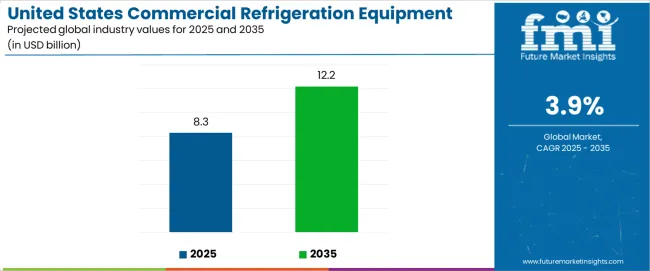
Key Takeaways, Market Size, and Forecast
| Metric | Value |
|---|---|
| Market Size (2025) | USD 8.3 Billion |
| Market Size (2035) | USD 12.2 Billion |
| CAGR (2025–2035) | 3.9% |
| Leading Product (2025) | Transportation Refrigeration Systems |
| Transportation Refrigeration Systems Share (2025) | 30.5% |
| Leading Application (2025) | Food Services |
| Food Services Share (2025) | 27.8% |
| Fastest-Growing Segment | Texas |
| Texas CAGR | 4.4% |
Between 2025 and 2030, United States commercial refrigeration equipment market is projected to expand from USD 8.3 billion to USD 10.0 billion, resulting in a value increase of USD 1.7 billion, which represents 43.6% of the total forecast growth for the decade. This phase of growth will be shaped by accelerating refrigerant transition mandates under EPA AIM Act implementation, expanding e-commerce cold chain infrastructure, and increasing replacement cycles for aging HFC-based systems. Growing modernization of food retail refrigeration, expansion of food service operations, and rising demand for last-mile refrigerated delivery capabilities continue to drive equipment adoption. Equipment suppliers are expanding their production capabilities to address regulatory compliance requirements and energy efficiency standards, with the United States leading adoption of low-GWP refrigerant technologies.
From 2030 to 2035, demand is forecast to grow from USD 10.0 billion to USD 12.2 billion, adding another USD 2.2 billion, which constitutes 56.4% of the overall ten-year expansion. This period is expected to be characterized by widespread adoption of CO₂ transcritical systems, integration of IoT-enabled monitoring and predictive maintenance technologies, and development of fully electric transport refrigeration solutions. The growing emphasis on sustainability initiatives, particularly in California and other progressive regulatory environments, will drive demand for natural refrigerants and zero-emission refrigeration systems across commercial applications.
Between 2020 and 2025, United States commercial refrigeration equipment market experienced steady expansion, growing from USD 7.4 billion to USD 8.3 billion. This growth was driven by recovery from pandemic disruptions, acceleration of cold chain logistics investments supporting online grocery delivery, and increasing awareness of energy efficiency benefits. The sector developed as food retailers, logistics providers, and food service operators recognized the need for modern refrigeration technologies to meet environmental regulations while reducing operational costs through improved energy performance and refrigerant compliance.
United States Commercial Refrigeration Equipment Market Analysis Key Takeaways
| Metric | Value |
|---|---|
| United States Commercial Refrigeration Equipment Market Sales Value (2025) | USD 8.3 billion |
| United States Commercial Refrigeration Equipment Market Forecast Value (2035) | USD 12.2 billion |
| United States Commercial Refrigeration Equipment Market Forecast CAGR (2025-2035) | 3.9% |
Why is the United States Commercial Refrigeration Equipment Market Growing?
Demand expansion is being supported by the rapid transformation of cold chain logistics infrastructure nationwide, driven by exponential growth in e-commerce grocery delivery, meal kit services, and direct-to-consumer food distribution models requiring sophisticated temperature-controlled storage and transportation. Modern food retail operations, logistics facilities, and food service establishments rely on advanced refrigeration equipment to ensure food safety compliance, minimize product loss, and optimize energy consumption. Commercial refrigeration requirements encompass comprehensive systems including walk-in coolers and freezers, refrigerated display cases, beverage dispensing equipment, and transport refrigeration units for trailers, trucks, and containers.
The accelerating regulatory transition away from high-GWP refrigerants is fundamentally reshaping equipment specifications and replacement cycles. The EPA's AIM Act implementation mandates HFC phasedown, compelling operators to adopt lower-GWP alternatives including HFO/HFC blends, natural refrigerants like CO₂ and hydrocarbons, and secondary refrigeration systems. California's CARB regulations establish even more stringent requirements, creating regional acceleration of equipment modernization. These regulatory imperatives are driving premature replacement of functional equipment, creating substantial demand for compliant systems.
Opportunity Pathways - United States Commercial Refrigeration Equipment Market
The United States commercial refrigeration equipment sector stands at a transformative inflection point where regulatory mandates, technological innovation, and operational imperatives converge. With demand projected to grow from USD 8.3 billion in 2025 to USD 12.2 billion by 2035-a robust 47.0% increase-the sector is being fundamentally restructured by refrigerant transition requirements, cold chain logistics expansion, and the pursuit of energy efficiency.
The confluence of EPA AIM Act implementation, state-level environmental regulations (particularly California's CARB standards), and corporate sustainability commitments creates accelerated demand for compliant technologies. Food retailers managing thousands of equipment assets face simultaneous pressures to reduce energy costs, minimize refrigerant emissions, and enhance food safety protocols.
Strategic pathways encompassing natural refrigerant leadership, transport refrigeration electrification, retrofit and conversion services, and digital monitoring ecosystems offer substantial margin enhancement opportunities for manufacturers and service providers positioned at the technology and regulatory compliance frontier.
Pathway A - Natural Refrigerant Systems Leadership. Regulatory pressure and corporate sustainability mandates accelerate adoption of natural refrigerants, particularly CO₂ transcritical systems for supermarkets and hydrocarbon-based systems for smaller applications. Equipment manufacturers offering proven solutions can command 20-30% price premiums while capturing fleet conversion opportunities. Expected revenue pool: USD 1.8-2.9 billion.
Pathway B - Low-GWP HFO/HFC Blend Solutions. A2L refrigerants represent the practical compliance solution for existing equipment architectures. Manufacturers developing comprehensive product lines can capture mainstream replacement demand while maintaining compatibility with existing service infrastructure. Potential: USD 2.4-3.8 billion.
Pathway C - Electric Transport Refrigeration Units. The logistics sector faces mounting pressure to eliminate diesel-powered auxiliary refrigeration engines. All-electric transport refrigeration systems can capture premium positioning as regulations tighten. Revenue opportunity: USD 1.4-2.3 billion.
Pathway D - Retrofit & Refrigerant Conversion Services. Comprehensive retrofit services enabling refrigerant conversion, component upgrades, and compliance certification represent high-margin recurring revenue. Service providers can achieve 35-45% gross margins while extending equipment lifecycles. Addressable opportunity: USD 1.9-3.2 billion.
Pathway E - Cold Chain Logistics & E-Commerce Infrastructure. Explosive growth in online grocery and meal delivery creates unprecedented demand for refrigerated warehousing, micro-fulfillment centers, and last-mile delivery assets. Expected revenue pool: USD 2.1-3.6 billion.
Pathway F - Food Service Equipment Modernization. The restaurant and food service sector represents fragmented replacement demand across diverse establishment types. Suppliers offering right-sized equipment with flexible financing can penetrate this vast installed base. Potential: USD 1.7-2.8 billion.
Pathway G - Connected Equipment & Predictive Maintenance Platforms. Integration of IoT sensors, cloud-based monitoring, and predictive analytics transforms refrigeration into managed service platforms. Manufacturers offering comprehensive digital ecosystems create recurring revenue streams. Expected uplift: USD 1.1-2.0 billion.
Pathway H - Energy Efficiency & Utility Incentive Optimization. Ultra-efficient equipment leveraging variable-speed compressors and advanced controls achieves rapid payback through utility cost savings. Strategic partnerships with utility incentive programs can accelerate adoption. Revenue opportunity: USD 1.5-2.6 billion.
Pathway I - Regulatory Compliance & Environmental Consulting Services. The complexity of refrigerant regulations creates demand for comprehensive regulatory management services. Providers offering compliance auditing and refrigerant management can capture high-margin professional services revenue. Addressable opportunity: USD 0.8-1.5 billion.
Pathway J - Regional High-Growth State Penetration. Texas, California, and Florida represent disproportionate growth opportunities driven by population expansion and logistics infrastructure development. Targeted penetration strategies can unlock substantial volume growth. Potential: USD 2.3-3.9 billion.
Segmental Analysis
Demand is segmented by product, application, and refrigerant/technology. By product, sales are divided into transportation refrigeration systems, refrigerators and freezers, refrigerated display and beverage equipment, ice machines, condensing units, and other specialized equipment. Based on application, demand is categorized into food services, food retail, logistics and transportation, food processing, healthcare, and hospitality sectors. In terms of refrigerant/technology, sales are segmented into lower-GWP HFO/HFC blends and advanced systems, legacy HFC systems, and natural refrigerants.
By Product, Transportation Refrigeration Systems Segment Accounts for 30.5% Share
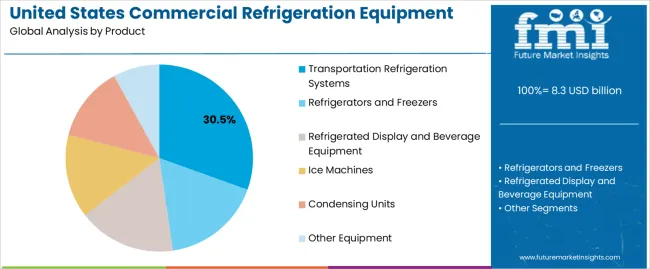
Transportation refrigeration systems are projected to account for 30.5% of United States commercial refrigeration equipment market in 2025, making it the leading product segment across the sector. This dominance reflects the critical expansion of cold chain logistics infrastructure driven by e-commerce grocery delivery, meal kit services, and increasing expectations for fresh and frozen product availability nationwide. The segment encompasses trailer refrigeration units (13.0% subsegment share) serving long-haul distribution networks connecting food manufacturers, distribution centers, and retail locations, truck refrigeration systems (10.5%) optimized for regional delivery routes and last-mile urban delivery operations, and shipping container refrigeration (7.0%) supporting international food trade through major port facilities and intermodal transportation networks.
The explosive growth of online grocery and food delivery services is fundamentally reshaping distribution networks, requiring multiplication of refrigerated transport assets to support direct-to-consumer models, distributed fulfillment strategies, and rapid delivery time commitments. Traditional centralized distribution approaches with large regional warehouses are being supplemented by micro-fulfillment centers positioned in urban areas closer to end consumers, each requiring dedicated refrigerated truck fleets for localized delivery operations. This transformation is generating unprecedented demand for smaller truck and van refrigeration systems specifically designed for frequent-stop urban routes with battery-electric or hybrid-electric powertrains meeting zero-emission zone requirements in progressive cities.
- E-commerce-driven cold chain expansion and last-mile delivery growth make transportation refrigeration the fastest-growing and most dynamic segment.
- Regulatory mandates for emissions reduction and electrification are accelerating fleet modernization cycles and advanced technology adoption across logistics operations.
By Application, Food Services Segment Accounts for 27.8% Share
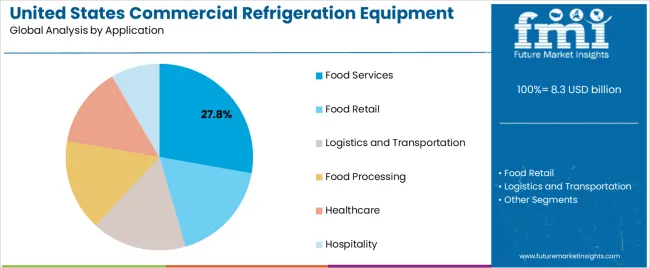
Food services represent 27.8% of United States commercial refrigeration equipment market in 2025, making it the leading application segment driven by the vast diversity and scale of food service establishments nationwide. The segment spans restaurants accounting for 15.0% subsegment share (encompassing full-service dining establishments, casual dining chains, and fine dining operations requiring comprehensive refrigeration infrastructure), convenience and quick-serve operations contributing 6.8% (including fast food franchises, coffee shops, and grab-and-go concepts prioritizing speed and equipment reliability), and catering and central kitchen facilities representing 6.0% (serving institutional food service, event catering, and emerging ghost kitchen concepts focused exclusively on delivery fulfillment).
The food service sector's equipment requirements span the complete spectrum of commercial refrigeration solutions, from walk-in coolers and freezers providing primary ingredient storage in back-of-house areas, to reach-in refrigeration units supporting kitchen preparation stations and cooking lines, under-counter refrigeration maximizing space efficiency in compact kitchen layouts, refrigerated prep tables integrating food storage with active preparation surfaces, customer-facing display cases for bakery items and prepared foods, and specialized equipment including blast chillers for rapid cooling, wine storage systems for beverage programs, and ice machines supporting beverage service operations across diverse establishment formats.
- Restaurant industry diversity creates demand across the full product spectrum, from economy equipment for independent operators to premium solutions for chains and fine dining establishments.
- Ghost kitchen and cloud kitchen proliferation is establishing new food service formats with distinct refrigeration requirements optimized for high-volume delivery operations rather than traditional dine-in service models.
What are the Drivers, Restraints, and Key Trends of the United States Commercial Refrigeration Equipment Market?
United States commercial refrigeration equipment market is advancing steadily due to regulatory-driven refrigerant transition, cold chain infrastructure expansion supporting e-commerce, and increasing emphasis on energy efficiency and operational cost reduction. However, the sector faces challenges including high upfront capital costs for advanced refrigeration technologies, technical complexity of natural refrigerant systems requiring specialized contractor capabilities, and economic uncertainty affecting discretionary equipment replacement decisions. Sustainability initiatives and corporate environmental commitments continue to influence equipment specifications and technology adoption patterns.
EPA AIM Act Implementation Accelerating Refrigerant Transition
The EPA's American Innovation and Manufacturing (AIM) Act is establishing mandatory HFC phasedown requirements that are fundamentally reshaping commercial refrigeration equipment specifications and replacement timelines. The legislation mandates 85% reduction in HFC production and consumption by 2036 relative to baseline levels, with progressive allocation reductions creating increasing scarcity for high-GWP refrigerants. Equipment operators face complex compliance decisions balancing refrigerant transition requirements, equipment replacement costs, and operational considerations. California's more aggressive refrigerant regulations under CARB authority are creating regional acceleration of technology transition.
Cold Chain Logistics Expansion Driven by E-Commerce Growth
The explosive growth of online grocery delivery, meal kit services, and direct-to-consumer specialty food distribution is fundamentally restructuring cold chain infrastructure requirements and creating unprecedented demand for refrigerated storage and transportation equipment. E-commerce grocery penetration continues expanding rapidly, with online orders projected to represent 15-20% of total grocery sales within the decade. Traditional centralized distribution models are being supplemented by micro-fulfillment centers located in urban areas, enabling rapid delivery while maintaining product quality. Last-mile delivery requirements are generating substantial demand for smaller refrigerated vehicles optimized for urban routes.
Analysis of United States Commercial Refrigeration Equipment Market by Key State
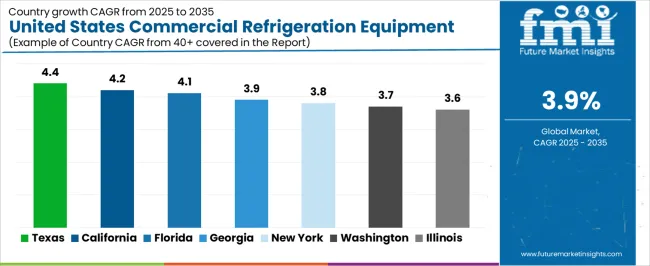
| State | CAGR (2025-2035) |
|---|---|
| Texas | 4.4% |
| California | 4.2% |
| Florida | 4.1% |
| Georgia | 3.9% |
| New York | 3.8% |
| Washington | 3.7% |
| Illinois | 3.6% |
United States commercial refrigeration equipment market demonstrates significant regional variation in growth patterns, driven by diverse factors including population dynamics, food retail expansion, logistics infrastructure development, regulatory environments, and industry concentration. Texas leads growth at 4.4% CAGR through 2035, reflecting robust grocery square footage expansion and major cold chain logistics hub development. California follows at 4.2% CAGR, driven primarily by aggressive CARB emissions regulations accelerating fleet equipment upgrades. Florida exhibits 4.1% growth supported by tourism and hospitality industry expansion and seaport-driven perishables handling.
Texas Leads National Growth with Infrastructure Expansion and Logistics Hub Development
Texas demonstrates exceptional growth at 4.4% CAGR through 2035, driven by rapid population expansion, extensive grocery retail development, and strategic cold chain logistics infrastructure investment. Houston's port complex serves as a critical international food trade gateway, creating concentrated demand for refrigerated warehousing and transport equipment across metropolitan areas. Major grocery chains are aggressively expanding store networks to serve growing urban populations.
Grocery square-footage expansion and large-scale cold-chain logistics operations centered around Houston's port facilities create substantial equipment procurement demand. Food processing corridor development supports advanced refrigeration technology adoption, enhancing operational efficiency and regulatory compliance positioning Texas as the national growth leader.
- Major grocery chains leading store network expansion across Dallas, Austin, San Antonio, and Houston metropolitan markets
- Houston port complex driving refrigerated warehousing and transport equipment demand for international food trade
- Population growth creating sustained grocery retail square footage increases throughout urban corridors
- Cold chain logistics infrastructure development supporting comprehensive equipment modernization programs
California Demonstrates Strong Potential with Regulatory Leadership
California exhibits robust growth at 4.2% CAGR, propelled by stringent CARB emissions regulations accelerating comprehensive fleet and equipment upgrade programs across commercial operations. Environmental compliance requirements and sustainability initiatives drive substantial demand for low-GWP refrigerant systems and energy-efficient technologies. Equipment suppliers and commercial operators implement extensive upgrade programs to meet California's rigorous regulatory framework.
CARB emissions rules accelerate fleet modernization while dense food retail concentration throughout metropolitan areas sustains consistent equipment demand. Professional training and certification programs develop specialized technical expertise among operators, enabling comprehensive equipment operation meeting California's environmental standards.
- CARB emissions regulations driving mandatory fleet and equipment upgrade programs across commercial operations
- Dense food retail concentration in Los Angeles, San Francisco, and San Diego sustaining equipment demand
- Low-GWP refrigerant systems adoption meeting stringent environmental compliance requirements
- Professional training programs enhancing technical capabilities for advanced refrigeration system operation
Florida Maintains Steady Growth with Tourism and Seaport Logistics
Florida sustains consistent growth at 4.1% CAGR through tourism and hospitality sector expansion combined with seaport-driven perishables and pharmaceutical logistics development. The state's commercial refrigeration sector integrates modern equipment technologies improving operational efficiency and food safety performance. Miami, Tampa, and Jacksonville seaports facilitate international trade requiring specialized refrigerated storage and transport equipment.
Tourism growth throughout Orlando, Miami, and Tampa drives hospitality refrigeration demand while seaport operations create concentrated logistics equipment requirements. Professional development programs enhance technical capabilities among commercial operations personnel, enabling specialized equipment operation meeting evolving food safety expectations.
- Tourism and hospitality growth driving refrigeration equipment demand across Orlando, Miami, and Tampa markets
- Seaport-driven perishables and pharmaceutical logistics creating specialized equipment procurement requirements
- International trade facilitation through Miami, Tampa, and Jacksonville ports requiring refrigerated storage systems
- Professional development programs enhancing technical expertise for food safety and efficiency compliance
Georgia Shows Steady Expansion with Food Processing and Atlanta Logistics Hub
Demand for commercial refrigeration equipment in Georgia is expanding at a CAGR of 3.9%, driven by the state's position as a major food processing corridor and Atlanta's role as a critical logistics hub serving Southeastern distribution networks. The state's poultry processing industry, representing the nation's largest concentration of chicken production and processing facilities, generates substantial demand for industrial refrigeration systems and cold storage infrastructure. Atlanta's Hartsfield-Jackson International Airport and extensive interstate highway network create concentrated logistics activity requiring refrigerated warehousing and distribution capabilities serving multi-state territories.
- Food processing corridor and Atlanta logistics hub expansion are creating significant equipment demand across Georgia's commercial and industrial refrigeration operations.
- Restaurant chains' retrofit cycles in Atlanta MSA are supporting ongoing equipment modernization and adoption of energy-efficient technologies across food service establishments.
New York Demonstrates Growth with Urban Grocery Modernization and E-Grocery Infrastructure
Demand for commercial refrigeration equipment in New York is projected to grow at a CAGR of 3.8%, driven by urban grocery modernization initiatives in New York City and surrounding metropolitan areas, combined with rapid expansion of e-grocery last-mile cold chain infrastructure supporting online delivery services. The state's dense urban population and sophisticated food retail environment create demand for specialized refrigeration solutions adapted to space-constrained store formats, multi-story buildings, and challenging installation environments. New York City's restaurant industry, representing one of the nation's largest and most diverse food service concentrations, generates consistent replacement demand across establishment types.
- Urban grocery modernization and e-grocery last-mile cold chain development are driving demand for specialized refrigeration solutions adapted to New York's unique urban environment.
- Professional workforce development programs are enhancing technical capabilities to support advanced equipment installation and service in complex urban commercial settings.
Washington Exhibits Growth with Fresh Produce Exports and Port-Linked Reefer Demand
Demand for commercial refrigeration equipment in Washington is growing at a CAGR of 3.7%, supported by the state's position as a major fresh produce and seafood exporter requiring extensive cold chain infrastructure from harvest through port export facilities. The Port of Seattle and Port of Tacoma handle substantial refrigerated cargo volumes serving Asian export markets, creating demand for container refrigeration, port-side cold storage, and supporting logistics infrastructure. Washington's apple production, representing a significant portion of national output, requires comprehensive cold storage facilities and refrigerated transportation serving domestic and international distribution.
- Fresh produce/seafood exports and port-linked reefer demand are creating equipment opportunities across Washington's agricultural and maritime logistics infrastructure.
- Sustainability initiatives in Seattle metropolitan area are driving adoption of natural refrigerants and energy-efficient equipment ahead of broader national trends.
Illinois Maintains Growth with Central Warehousing and Chicago MSA Restaurant Chains
Demand for commercial refrigeration equipment in Illinois is projected to expand at a CAGR of 3.6%, driven by the state's central geographic position supporting major warehousing and distribution operations serving Midwest and national territories, combined with substantial food service infrastructure in Chicago metropolitan area. The concentration of food distribution centers, cold storage facilities, and logistics operations around Chicago creates ongoing demand for large-scale industrial refrigeration systems and refrigerated warehouse infrastructure. Chicago's restaurant industry, including major chain headquarters and diverse independent establishments, generates consistent equipment replacement demand.
- Central warehousing and restaurant chains' retrofit cycles in Chicago MSA are supporting equipment demand across Illinois commercial refrigeration operations.
- Food manufacturing and processing facilities throughout the state require comprehensive refrigeration infrastructure supporting production and distribution activities.
Competitive Landscape of United States Commercial Refrigeration Equipment Market
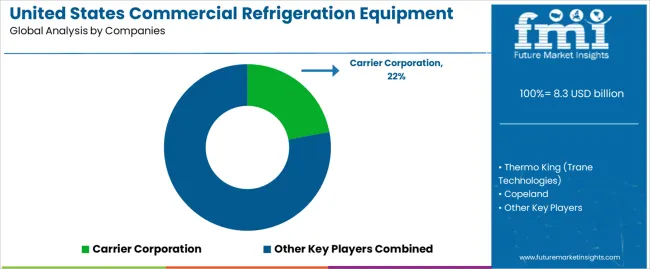
United States commercial refrigeration equipment market is defined by competition among specialized equipment manufacturers, technology providers, and service companies. Manufacturers are investing in advanced equipment technologies, low-GWP refrigerant systems, IoT-enabled monitoring capabilities, and comprehensive service networks to deliver reliable, efficient, and compliant refrigeration solutions. Strategic partnerships, technological innovation, and product portfolio expansion are central to strengthening presence across the United States.
Carrier Corporation, United States-based and an industry leader, leads the market with 22% share and offers comprehensive commercial refrigeration equipment including transport refrigeration, display cases, and refrigeration systems with focus on energy efficiency, regulatory compliance, and digital monitoring across commercial applications. Thermo King (Trane Technologies), operating from the United States, provides advanced transport refrigeration solutions, electric refrigeration systems, and telematics integration with emphasis on innovation and emissions reduction.
Copeland delivers technologically advanced refrigeration compressors, controls, and system solutions serving food retail, food service, and logistics applications. Dover, through its Hillphoenix and Advansor brands, emphasizes comprehensive retail refrigeration systems with integrated CO₂ solutions and advanced monitoring. Hussmann (Panasonic) offers specialized display cases, refrigeration systems, and energy management solutions for supermarket and convenience store applications.
Key Players in United States Commercial Refrigeration Equipment Market
- Carrier Corporation
- Thermo King (Trane Technologies)
- Copeland
- Dover (Hillphoenix & Advansor)
- Hussmann (Panasonic)
- True Manufacturing
- Heatcraft Worldwide Refrigeration (Lennox)
- Manitowoc Ice (Welbilt)
- Danfoss
- Johnson Controls
Scope of the Report
| Item | Value |
|---|---|
| Quantitative Units | USD 8.3 billion |
| Product | Transportation refrigeration systems (trailer refrigeration, truck refrigeration, shipping container systems), refrigerators and freezers (walk-in refrigerators/freezers, reach-in refrigerators/freezers), refrigerated display and beverage equipment (refrigerated display cases, beverage refrigeration/dispensing including beer and soda), ice machines, condensing units, other equipment |
| Application | Food services (restaurants, convenience and quick-serve, catering/central kitchens), food retail (supermarkets/hypermarkets, small format and specialty), logistics and transportation (last-mile/urban delivery, long-haul trailers), food processing, healthcare, hospitality |
| Refrigerant/Technology | Lower-GWP HFO/HFC blends and advanced systems (HFO/HFC A2L adoption, secondary/indirect systems), legacy HFC systems (R404A/R407 variants), natural refrigerants (CO₂ transcritical/booster, hydrocarbons) |
| States Covered | Texas, California, Florida, Georgia, New York, Washington, Illinois |
| Key Companies Profiled | Carrier Corporation, Thermo King (Trane Technologies), Copeland, Dover (Hillphoenix & Advansor), Hussmann (Panasonic), True Manufacturing, Heatcraft Worldwide Refrigeration (Lennox), Manitowoc Ice (Welbilt), Danfoss, Johnson Controls |
| Additional Attributes | Dollar sales by product type, application segment, and refrigerant/technology, state-level demand trends, competitive landscape with established manufacturers and technology innovators, regulatory compliance dynamics with EPA AIM Act and state-level requirements, integration with IoT monitoring and predictive maintenance systems, innovations in natural refrigerants and low-GWP technologies, and adoption of electric transport refrigeration, energy management platforms, and advanced food safety features for enhanced operational efficiency across commercial applications |
United States Commercial Refrigeration Equipment Market by Segments
Product:
- Transportation Refrigeration Systems
- Trailer Refrigeration
- Truck Refrigeration
- Shipping Container Systems
- Refrigerators and Freezers
- Walk-in Refrigerators/Freezers
- Reach-in Refrigerators/Freezers
- Refrigerated Display and Beverage Equipment
- Refrigerated Display Cases
- Beverage Refrigeration/Dispensing (including beer and soda)
- Ice Machines
- Condensing Units
- Other Equipment
Application:
- Food Services
- Restaurants
- Convenience and Quick-Serve
- Catering/Central Kitchens
- Food Retail
- Supermarkets/Hypermarkets
- Small Format and Specialty
- Logistics and Transportation
- Last-Mile/Urban Delivery
- Long-Haul Trailers
- Food Processing
- Healthcare
- Hospitality
Refrigerant/Technology:
- Lower-GWP HFO/HFC Blends and Advanced Systems
- HFO/HFC A2L Adoption in New Cases/Systems
- Secondary/Indirect Systems
- Legacy HFC Systems
- R404A/R407 Variants (in operation/retrofit)
- Natural Refrigerants
- CO₂ (R744) Transcritical/Booster
- Hydrocarbons (R290/R600a) in Cases/Plug-ins
States:
- Texas
- California
- Florida
- Georgia
- New York
- Washington
- Illinois
Frequently Asked Questions
How big is the united states commercial refrigeration equipment market in 2025?
The global united states commercial refrigeration equipment market is estimated to be valued at USD 8.3 billion in 2025.
What will be the size of united states commercial refrigeration equipment market in 2035?
The market size for the united states commercial refrigeration equipment market is projected to reach USD 12.2 billion by 2035.
How much will be the united states commercial refrigeration equipment market growth between 2025 and 2035?
The united states commercial refrigeration equipment market is expected to grow at a 3.9% CAGR between 2025 and 2035.
What are the key product types in the united states commercial refrigeration equipment market?
The key product types in united states commercial refrigeration equipment market are transportation refrigeration systems, refrigerators and freezers, refrigerated display and beverage equipment , ice machines, condensing units and other equipment.
Which application segment to contribute significant share in the united states commercial refrigeration equipment market in 2025?
In terms of application, food services segment to command 27.8% share in the united states commercial refrigeration equipment market in 2025.
Preview the report firsthand - request a free sample
Get SampleGet the brochure for pricing and purchase details.
Get PDFTable of Content
- Executive Summary
- Global Market Outlook
- Demand-side Trends
- Supply-side Trends
- Technology Roadmap Analysis
- Analysis and Recommendations
- Market Overview
- Market Coverage / Taxonomy
- Market Definition / Scope / Limitations
- Market Background
- Market Dynamics
- Drivers
- Restraints
- Opportunity
- Trends
- Scenario Forecast
- Demand in Optimistic Scenario
- Demand in Likely Scenario
- Demand in Conservative Scenario
- Opportunity Map Analysis
- Product Life Cycle Analysis
- Supply Chain Analysis
- Investment Feasibility Matrix
- Value Chain Analysis
- PESTLE and Porter’s Analysis
- Regulatory Landscape
- Regional Parent Market Outlook
- Production and Consumption Statistics
- Import and Export Statistics
- Market Dynamics
- Global Market Analysis 2020 to 2024 and Forecast, 2025 to 2035
- Historical Market Size Value (USD Billion) Analysis, 2020 to 2024
- Current and Future Market Size Value (USD Billion) Projections, 2025 to 2035
- Y-o-Y Growth Trend Analysis
- Absolute $ Opportunity Analysis
- Global Market Pricing Analysis 2020 to 2024 and Forecast 2025 to 2035
- Global Market Analysis 2020 to 2024 and Forecast 2025 to 2035, By Product
- Introduction / Key Findings
- Historical Market Size Value (USD Billion) Analysis By Product , 2020 to 2024
- Current and Future Market Size Value (USD Billion) Analysis and Forecast By Product , 2025 to 2035
- Transportation Refrigeration Systems
- Refrigerators and Freezers
- Refrigerated Display and Beverage Equipment
- Ice Machines
- Condensing Value (USD Billion)s
- Other Equipment
- Y-o-Y Growth Trend Analysis By Product , 2020 to 2024
- Absolute $ Opportunity Analysis By Product , 2025 to 2035
- Global Market Analysis 2020 to 2024 and Forecast 2025 to 2035, By Application
- Introduction / Key Findings
- Historical Market Size Value (USD Billion) Analysis By Application, 2020 to 2024
- Current and Future Market Size Value (USD Billion) Analysis and Forecast By Application, 2025 to 2035
- Food Services
- Food Retail
- Logistics and Transportation
- Food Processing
- Healthcare
- Hospitality
- Y-o-Y Growth Trend Analysis By Application, 2020 to 2024
- Absolute $ Opportunity Analysis By Application, 2025 to 2035
- Global Market Analysis 2020 to 2024 and Forecast 2025 to 2035, By Region
- Introduction
- Historical Market Size Value (USD Billion) Analysis By Region, 2020 to 2024
- Current Market Size Value (USD Billion) Analysis and Forecast By Region, 2025 to 2035
- North America
- Latin America
- Western Europe
- Eastern Europe
- East Asia
- South Asia and Pacific
- Middle East & Africa
- Market Attractiveness Analysis By Region
- North America Market Analysis 2020 to 2024 and Forecast 2025 to 2035, By Country
- Historical Market Size Value (USD Billion) Trend Analysis By Market Taxonomy, 2020 to 2024
- Market Size Value (USD Billion) Forecast By Market Taxonomy, 2025 to 2035
- By Country
- USA
- Canada
- Mexico
- By Product
- By Application
- By Country
- Market Attractiveness Analysis
- By Country
- By Product
- By Application
- Key Takeaways
- Latin America Market Analysis 2020 to 2024 and Forecast 2025 to 2035, By Country
- Historical Market Size Value (USD Billion) Trend Analysis By Market Taxonomy, 2020 to 2024
- Market Size Value (USD Billion) Forecast By Market Taxonomy, 2025 to 2035
- By Country
- Brazil
- Chile
- Rest of Latin America
- By Product
- By Application
- By Country
- Market Attractiveness Analysis
- By Country
- By Product
- By Application
- Key Takeaways
- Western Europe Market Analysis 2020 to 2024 and Forecast 2025 to 2035, By Country
- Historical Market Size Value (USD Billion) Trend Analysis By Market Taxonomy, 2020 to 2024
- Market Size Value (USD Billion) Forecast By Market Taxonomy, 2025 to 2035
- By Country
- Germany
- UK
- Italy
- Spain
- France
- Nordic
- BENELUX
- Rest of Western Europe
- By Product
- By Application
- By Country
- Market Attractiveness Analysis
- By Country
- By Product
- By Application
- Key Takeaways
- Eastern Europe Market Analysis 2020 to 2024 and Forecast 2025 to 2035, By Country
- Historical Market Size Value (USD Billion) Trend Analysis By Market Taxonomy, 2020 to 2024
- Market Size Value (USD Billion) Forecast By Market Taxonomy, 2025 to 2035
- By Country
- Russia
- Poland
- Hungary
- Balkan & Baltic
- Rest of Eastern Europe
- By Product
- By Application
- By Country
- Market Attractiveness Analysis
- By Country
- By Product
- By Application
- Key Takeaways
- East Asia Market Analysis 2020 to 2024 and Forecast 2025 to 2035, By Country
- Historical Market Size Value (USD Billion) Trend Analysis By Market Taxonomy, 2020 to 2024
- Market Size Value (USD Billion) Forecast By Market Taxonomy, 2025 to 2035
- By Country
- China
- Japan
- South Korea
- By Product
- By Application
- By Country
- Market Attractiveness Analysis
- By Country
- By Product
- By Application
- Key Takeaways
- South Asia and Pacific Market Analysis 2020 to 2024 and Forecast 2025 to 2035, By Country
- Historical Market Size Value (USD Billion) Trend Analysis By Market Taxonomy, 2020 to 2024
- Market Size Value (USD Billion) Forecast By Market Taxonomy, 2025 to 2035
- By Country
- India
- ASEAN
- Australia & New Zealand
- Rest of South Asia and Pacific
- By Product
- By Application
- By Country
- Market Attractiveness Analysis
- By Country
- By Product
- By Application
- Key Takeaways
- Middle East & Africa Market Analysis 2020 to 2024 and Forecast 2025 to 2035, By Country
- Historical Market Size Value (USD Billion) Trend Analysis By Market Taxonomy, 2020 to 2024
- Market Size Value (USD Billion) Forecast By Market Taxonomy, 2025 to 2035
- By Country
- Kingdom of Saudi Arabia
- Other GCC Countries
- Turkiye
- South Africa
- Other African Union
- Rest of Middle East & Africa
- By Product
- By Application
- By Country
- Market Attractiveness Analysis
- By Country
- By Product
- By Application
- Key Takeaways
- Key Countries Market Analysis
- USA
- Pricing Analysis
- Market Share Analysis, 2024
- By Product
- By Application
- Canada
- Pricing Analysis
- Market Share Analysis, 2024
- By Product
- By Application
- Mexico
- Pricing Analysis
- Market Share Analysis, 2024
- By Product
- By Application
- Brazil
- Pricing Analysis
- Market Share Analysis, 2024
- By Product
- By Application
- Chile
- Pricing Analysis
- Market Share Analysis, 2024
- By Product
- By Application
- Germany
- Pricing Analysis
- Market Share Analysis, 2024
- By Product
- By Application
- UK
- Pricing Analysis
- Market Share Analysis, 2024
- By Product
- By Application
- Italy
- Pricing Analysis
- Market Share Analysis, 2024
- By Product
- By Application
- Spain
- Pricing Analysis
- Market Share Analysis, 2024
- By Product
- By Application
- France
- Pricing Analysis
- Market Share Analysis, 2024
- By Product
- By Application
- India
- Pricing Analysis
- Market Share Analysis, 2024
- By Product
- By Application
- ASEAN
- Pricing Analysis
- Market Share Analysis, 2024
- By Product
- By Application
- Australia & New Zealand
- Pricing Analysis
- Market Share Analysis, 2024
- By Product
- By Application
- China
- Pricing Analysis
- Market Share Analysis, 2024
- By Product
- By Application
- Japan
- Pricing Analysis
- Market Share Analysis, 2024
- By Product
- By Application
- South Korea
- Pricing Analysis
- Market Share Analysis, 2024
- By Product
- By Application
- Russia
- Pricing Analysis
- Market Share Analysis, 2024
- By Product
- By Application
- Poland
- Pricing Analysis
- Market Share Analysis, 2024
- By Product
- By Application
- Hungary
- Pricing Analysis
- Market Share Analysis, 2024
- By Product
- By Application
- Kingdom of Saudi Arabia
- Pricing Analysis
- Market Share Analysis, 2024
- By Product
- By Application
- Turkiye
- Pricing Analysis
- Market Share Analysis, 2024
- By Product
- By Application
- South Africa
- Pricing Analysis
- Market Share Analysis, 2024
- By Product
- By Application
- USA
- Market Structure Analysis
- Competition Dashboard
- Competition Benchmarking
- Market Share Analysis of Top Players
- By Regional
- By Product
- By Application
- Competition Analysis
- Competition Deep Dive
- Carrier Corporation
- Overview
- Product Portfolio
- Profitability by Market Segments (Product/Age /Sales Channel/Region)
- Sales Footprint
- Strategy Overview
- Marketing Strategy
- Product Strategy
- Channel Strategy
- Thermo King (Trane Technologies)
- Copeland
- Dover (Hillphoenix & Advansor)
- Hussmann (Panasonic)
- True Manufacturing
- Heatcraft Worldwide Refrigeration (Lennox)
- Manitowoc Ice (Welbilt)
- Danfoss
- Johnson Controls
- Carrier Corporation
- Competition Deep Dive
- Assumptions & Acronyms Used
- Research Methodology


